£ GBP
£ GBP

Avid cyclists who live life on two wheels may start to notice some niggling pains and stiffness here and there. While cycling builds strength and endurance, it can also lead to tight shoulders, necks, hip flexors, hamstrings, calves, glutes, and IT bands, plus a rounded spine.
A regular cross-training yoga routine can create balance by stretching your legs and opening your chest while also building core strength. Here are some ways to complement your cycling with yoga.
The 10 Best Yoga Poses for Cyclists
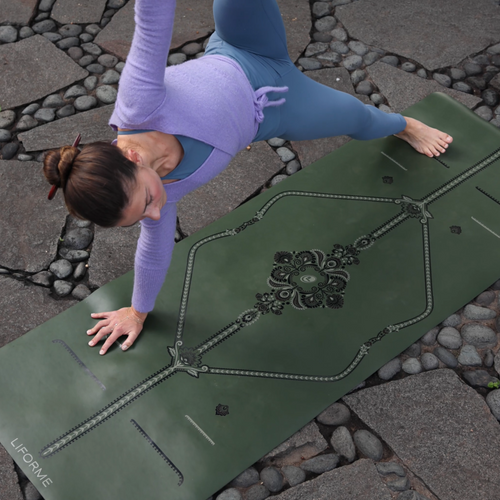
 Featured Yoga Mat: Liforme Classic Yoga Mat in Green
Reverse Table Pose (Ardha Purvottanasana)
Sanskrit Meaning: Ardha (Half) Purva (East, the front of the body) Tan (Stretch) Asana (Pose)
Yoga Level: Beginner
Pose Type: Arm Support
Why This Pose: Counters the rounding of the spine and strengthens the glutes
Step-by-Step Instructions:
1. Begin in Staff Pose with your palms on the floor outside your hips.
2. Bend your knees, bringing the soles of your feet to the mat about a foot away from your butt.
3. Press into your hands and feet and use your glutes to lift your hips off the floor.
4. Keep your shoulders over your wrists and your knees over your ankles.
5. Tuck your chin slightly, take your gaze to the ceiling, or release your head back.
6. Take several breaths, then lower your hips to the floor.
 Featured Yoga Mat: Liforme Classic Yoga Mat in Grey
Sphinx Pose (Salamba Bhujangasana)
Sanskrit Meaning: Salamba (Supported) Bhujanga (Cobra) Asana (Pose)
Yoga Level: Beginner
Pose Type: Prone
Why This Pose: Counters hunched posture
Step-by-Step Instructions:
1. Lie on your stomach.
2. Lift your upper body, aligning your elbows under your shoulders for support.
3. Keep your forearms parallel.
4. Press into your hands and forearms to lift your chest and keep your shoulders down.
 Featured Yoga Mat: Blossoming Lotus in Purple
Cat-Cow Stretch (Marjaryasana-Bitilasana)
Sanskrit Meaning: Marjary (Cat) Asana (Pose) Bitila (Cow) Pose (Asana)
Yoga Level: Beginner
Pose Type: Kneeling
Why This Pose: Activates spinal mobility and opens your chest
Step-by-Step Instructions:
1. Begin on your hands and knees with your shoulders over your wrists and your hips over your knees.
2. On an inhalation of breath, lift your tail, lower your belly, and lift your head.
3. On your next exhalation, tuck your tail, round your spine, and drop your head.
4. Continue moving back and forth between spinal extension and flexion on each inhale and exhale for five to ten breaths.
 Featured Yoga Mat: Liforme Classic Yoga Mat in Purple
Downward Facing Dog (Adho Mukha Svanasana)
Sanskrit Meaning: Adho (Downward) Mukha (Face) Svanasana (Dog)
Yoga Level: Beginner
Pose Type: Standing
Why This Pose: Stretches your hamstrings and calves
Step-by-Step Instructions:
1. Begin on your hands and knees.
2. Curl your toes under and press into your palms to lift your hips toward the ceiling, coming into an inverted V position.
3. Relax your shoulders away from your ears.
4. Bend your knees one at a time and release the opposite heel towards the floor.
5. Take five to ten deep breaths.
 Featured Yoga Mat: Liforme Classic Yoga Mat in Maroon
Standing Crescent Variation (Urdhva Hastanana)
Sanskrit Meaning: Urdhva (Upward) Hasta (Hands) Asana (Pose)
Yoga Level: Beginner
Pose Type: Standing
Why This Pose: This crisscross variation stretches your IT bands, intercostals, and shoulders.
Step-by-Step Instructions:
1. Begin in Mountain Pose.
2. Cross your right foot in front of your left foot so your pinkie toes are touching.
3. Inhale to bring your arms overhead.
4. Hold your left wrist with your right hand.
5. Arc up and over to the right, opening your ribs.
6. Take your gaze up under your left arm.
7. Take several breaths, then switch sides.
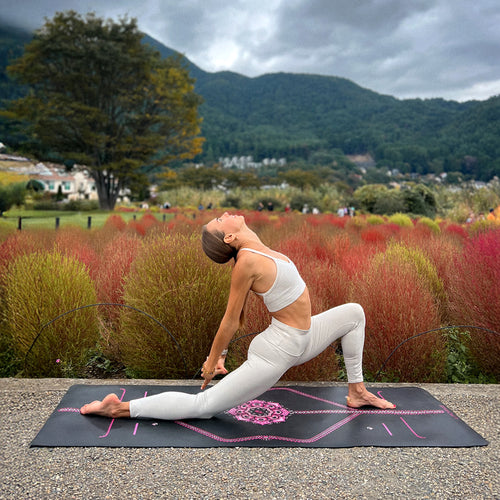
 Featured Yoga Mat: Cosmic Moon in Black
Standing Forward Fold (Uttanasana)
Sanskrit Meaning: Uttana (Intense Stretch) Asana (Pose)
Yoga Level: Beginner
Pose Type: Standing
Why This Pose: Stretches your hamstrings and releases the neck and shoulders. Add an IT band stretch by crisscrossing your legs.
Step-by-Step Instructions:
1. Begin in Mountain Pose.
2. Inhale to take your arms overhead.
3. Exhale to swan dive over your legs into a forward fold.
4. Let your arms and head dangle.
5. Stay here for five to ten breaths to really let go.

Crescent Lunge (Anjaneyasana)
Sanskrit Meaning: Anjani (Hindu goddess) Asana (Pose)
Yoga Level: Beginner
Pose Type: Kneeling
Why This Pose: Stretches your hip flexors and quads and opens your chest
Step-by-Step Instructions:
1. Begin on your hands and knees.
2. Step your right foot to the inside of your right hand.
3. Take extra padding under your left knee if it's uncomfortable.
4. Bring your hands to your hips.
5. Deepen the bend in your right knee to intensify the stretch.
6. Take your arms overhead.
7. Lift your chest to come into a slight backbend.
8. After several breaths, move on to Pigeon.

Pigeon Pose (Eka Pada Rajakoptasana)
Sanskrit Meaning: Eka (One) Pada (Foot) Raja (King) Kapota (Pigeon) Asana (Pose)
Yoga Level: Beginner
Pose Type: Seated
Why This Pose: Opens the hip flexors
Step-by-Step Instructions:
1. From Crescent Lunge, shift your right foot across your mat towards your left hand and lower your right knee to the floor so your right shin is flat on the mat.
2. You may need to tuck your left toes under and scoot your foot back to lower the top of your left thigh to the floor.
3. If your right buttock is not on the floor, use a blanket under it for support.
4. Forward bend over your right shin, putting as much weight as you like on the right leg to intensify the stretch.
5. After five to ten breaths, lift your torso to transition into a Seated Spinal Twist.

Seated Spinal Twist (Ardha Matsyendrasana)
Sanskrit Meaning: Ardha (Half) Matsyendra (Lord of Fishes) Asana (Pose)
Yoga Level: Beginner
Pose Type: Seated
Why This Pose: Stretches the glutes and IT bands
Step-by-Step Instructions:
1. From Pigeon Pose, swing your leg forward and bend your knee to bring the sole of your left foot to the floor outside your right thigh.
2. Make sure both sitbones are grounded.
3. Inhale and lift your arms.
4. Exhale and twist to the left, taking your right elbow outside your left knee and your left hand to the floor behind your back.
5. Continue to lengthen your spine on each inhale and deepen your twist on each exhale for at least five breaths.
6. Come back to center and return to your hands and knees position to repeat these three poses with your left leg forward. You can also do both sides of each pose without linking them into a sequence if you prefer.

Bridge Pose (Setu Bandhasana)
Sanskrit Meaning: Setu (Bridge) Bandha (Lock) Asana (Pose)
Yoga Level: Beginner
Pose Type: Supine
Why This Pose: Strengthens your core and glutes, and opens your chest and shoulders
Step-by-Step Instructions:
1. Lie on your back with your knees bent and your heels close to your glutes.
2. Inhale to press into your feet and lift your hips off the mat.
3. Tuck your shoulders under and interlace your hands behind your back.
4. Take at least five deep breaths before releasing your hands and lowering your hips.
Benefits of Yoga for Cyclists
-
Opens your chest and improves posture
-
Stretches your hamstrings, IT bands, and hip flexors
-
Strengthens your glutes.
-
Aids recovery and helps prevent injuries.
Tips for Practicing Yoga as a Cyclist
Do Deep Stretching when Warm
Warm muscles stretch better with less risk than cool ones. A few well-chosen stretches after your ride can go a long way.
Be Consistent
For best results, plan regular yoga sessions into your exercise routine. You don’t have to do an hour of yoga every time. Consistent shorter practices can also be effective.
Use Props
Yoga props like blocks, blankets, and straps support safe alignment as your body becomes more flexible. Using them helps you get the best stretch without compromising your form.
Ride On
When you love to cycle, you want to keep your body feeling good so you can stay on your bike. Yoga is all about helping you keep fit so you can do the things that support your physical and mental health. Add a few yoga sessions a week to your routine and your cycling will benefit enormously.
FAQs About Yoga for Cyclists
Is yoga good for cyclists?
Very good! Yoga is great cross-training for cyclists because you can address multiple areas of the body with just a few poses.
Is yoga for cyclists better before or after a ride?
It’s much better to stretch after a ride, but also try to get in some yoga sessions independent of your cycling schedule.
Which yoga poses are best for tight hips in cyclists?
Pigeon Pose is a good candidate. If you find Pigeon to be very intense, try a Reclined Pigeon (Sucirandhrasana) instead.

Can yoga help with knee pain from cycling?
See a doctor to find out what is causing your knee pain. If it’s a result of weak glutes, hamstrings, or core, or tight hip flexors or quads, then yoga can help.
How often should cyclists practice yoga?
A regular yoga practice routine is essential. Aim for two or three times per week. It’s better to do a little bit each day than a longer session less frequently.
Do I need any yoga experience to get started?
Not at all! Complete beginners should take a look at our Beginner’s Guide for more info on how to get started.