£ GBP
£ GBP

Whenever someone mentions poses for hip flexibility, yoga minds immediately jump to Pigeon Pose, which is indeed a classic and excellent way to get deep into the muscles that connect the legs and pelvis, also known as the hips. These muscles can get very tight in the course of an adult life of sitting, driving, maybe walking a bit, and then sitting some more, so Pigeon also has a reputation for being a very intense posture. But no one has to fear the Pigeon because there are numerous variations and ways to use props that make a version of this hip opener possible for almost anyone.
Pigeon Pose vs. One-Legged King Pigeon Pose
First off, what most of us commonly call Pigeon is actually a preparation for the full posture known as Eka Pada Rajakapotasana, meaning One-Legged King Pigeon Pose. In the full pose, the back leg is bent, and both hands reach up and over the shoulders to grasp the back foot. The spine comes into deep extension to allow the back foot to move towards the crown of the head. The full expression requires not only open hips, but open shoulders, deep back-bending, and balance, making it quite an advanced posture.
The version that we most often encounter in class isolates our attention on the hips because the back leg is kept in an extended position, and the torso is often draped over the front leg to help gravity do its thing. But even that can be too uncomfortable at first, so there are gentler options available.
In this guide, we’re going to begin with the most accessible variations and work our way up to the full posture.
Sucirandhrasana (Eye of the Needle Pose)
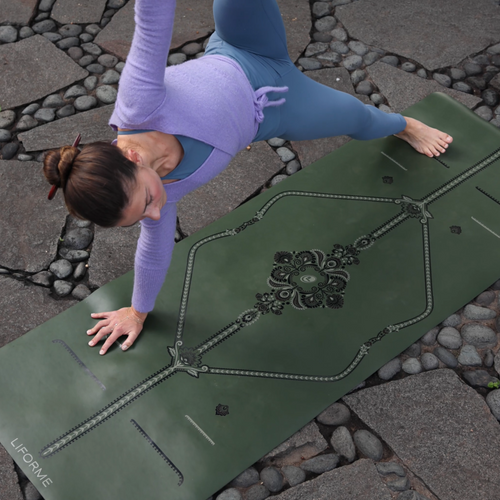
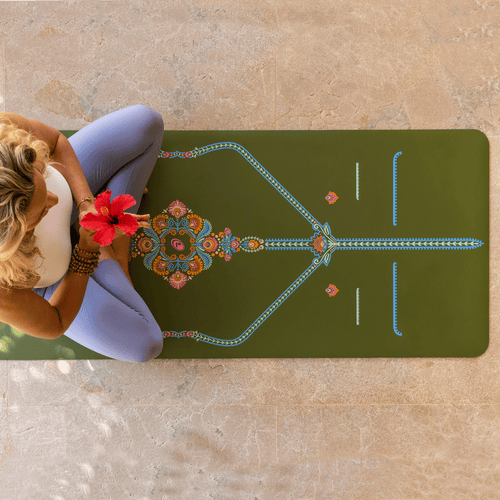
 Featured Yoga Mat: Liforme Classic Yoga Mat in Green
You may think this doesn’t look much like a Pigeon, but it offers much the same stretch in a way that allows for a lot more user control. So let’s call it Supine Pigeon. It’s a great place to start if you have super-tight hips.
Step-by-Step Instructions for Eye of the Needle Pose
- Lie on your back with both knees bent toward the ceiling and the soles of your feet flat on the floor.
- Place your right ankle on the top of your left thigh with the right knee pointing out to the right.
- Lift your left foot from the floor. Keep both feet flexed.
- Reach your right hand through your legs and your left hand around the left side to clasp your hands behind your right thigh.
- Draw your left thigh in towards your chest. Your right knee continues to move away from your chest.
Pigeon Pose Prep (Eka Pada Rajakapotasana Prep)
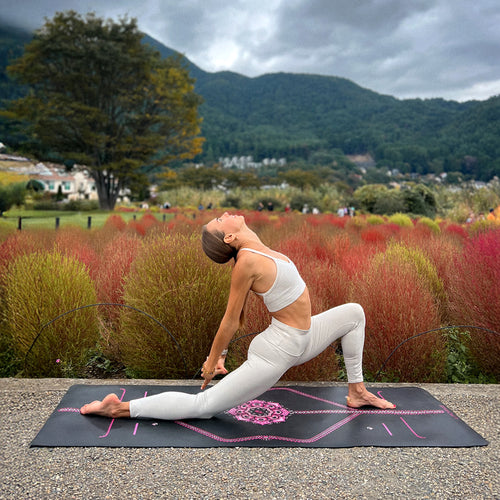
 Featured Yoga Mat: Liforme Classic Yoga Mat in Grey
This is what most of us just call Pigeon. When upright, try to keep your weight from shifting off to one side. To add a little pressure to your front leg and intensify the stretch, take a forward fold.
Step-by-Step Instructions for Pigeon Pose Prep
- From Downward Facing Dog, step your right foot forward, landing your right knee just to the outside of your right wrist and your right ankle behind your left wrist. The front side of your left leg will come to the floor.
- Let your right foot land wherever feels comfortable between your left wrist and your left hip point. Moving the foot closer to the wrist can cause discomfort in your right knee, so don’t put it in a position that’s painful.
- Once you have your front leg situated, tuck your left toes under and scoot your left knee a little further back on your mat.
- Release the top of your left foot to the floor with the toes pointing straight back. Square your hips to the front of the mat. This may mean that there's a big gap between your right buttock and the floor, and that is perfectly ok. If your right hip is lifted, place a folded blanket underneath for support.
- Stay upright, or fold forward over your right leg any amount.
- If comfortable, come down to your elbows or bring your forehead all the way to the mat.
- Hold for 5-10 breaths, then switch sides.
🧘 Tip from a Yogi
Pigeon is one of those poses where release can continue to happen when you stay put, especially since you’re using gravity to help you along. Once you get to a place that is comfortably edgy (meaning you feel like something is happening but it’s not going to kill you), stay for five to ten breaths, or even more if you like.
Mermaid Pose
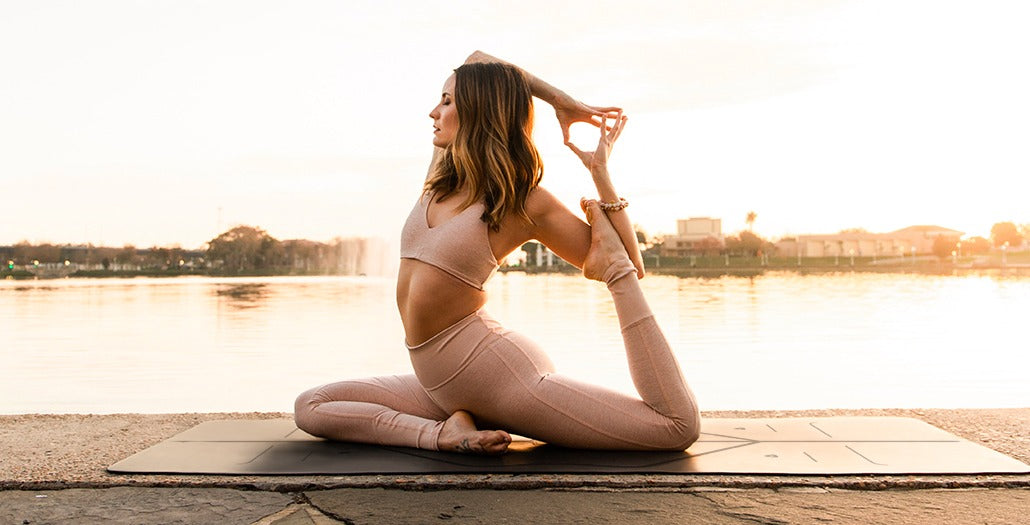 Featured Yoga Mat: Liforme Classic Yoga Mat in Grey
Mermaid takes you a step closer to One-Legged King Pigeon by introducing a backbend, shoulder stretch, and quad stretch. That said, it’s still a lot more accessible than the full pose and can be made even more so with the help of a strap.
Step-by-Step Instructions for Mermaid Pose:
- From Pigeon, bend your left knee and bring your left heel toward your left buttock.
- Reach your left hand behind you and take hold of the inside of your left foot.
- At this point, things can become a little tippy, so make sure that you have padding under the right buttock if necessary, so that you don’t start falling over to the right side.
- Alternatively, firm both thighs and press strongly down through both knees into the floor. This has the effect of bringing your pelvis a bit higher but stabilizing it so that you don’t collapse to one side.
- If you want to go further, slide your left foot into the crook of your left elbow. Keep both feet active.
- To complete the posture, reach your right arm up to the ceiling. Bend your right elbow so that your right hand drops behind your back and you are able to clasp your right and left hands together. If they don’t meet, you can use a strap between them instead.
- Press the back of your head into your right arm and open your chest toward the front of the room.
One-Legged King Pigeon Pose (Eka Pada Rajakapotasana)
 Featured Yoga Mat: Mindful Garden Yoga Mat in Purple
Mermaid actually takes you a good bit of the way toward Full Pigeon and provides a good point of entry. A strap is really helpful for people with tight shoulders.
Step-by-Step Instructions for One-Legged King Pigeon Pose:
- From Mermaid, release your overhead grip but keep your left foot in the crook of your left elbow and hugging in toward your left buttock.
- Reach your right arm across the front of your chest and grab the toes of your left foot with your right hand.
- Bring your left arm up to the ceiling while turning your chest toward the front of the mat.
- Bend your left elbow and drop your left hand over your shoulder and behind your back to reach for the left toes.
- Release your right hand and extend that arm toward the ceiling. Bend your right elbow to drop your right hand behind your back and reach your left toes. At this point, your arms are in a symmetrical position: elbows pointing toward the ceiling, hands dropped behind the back and holding the left foot. If this isn’t possible, loop a strap over the left foot and hold it with both hands.
- Open your chest and throat toward the ceiling and extend the crown of your head back toward your left foot.
Flying Pigeon (Eka Pada Galavasana)
 Featured Yoga Mat: Radiant Sun Yoga Mat in Yellow
If your Pigeon is pretty strong, it might be ready to take flight. This arm balance is based on the same leg position as Pigeon Prep.
Step-by-Step Instructions for Flying Pigeon Pose
- From Mountain Pose, soften both knees. Lift your right foot from the floor and bring your right ankle to the top of your left thigh (this position might be familiar from Eye of the Needle).
- Forward fold over both legs, bending the left knee to bring both palms flat on the floor in front of you.
- Hook your right foot strongly around your left upper arm.
- Continue bending your left knee until the right knee rests on the right upper arm. Bend your elbows back towards a Chaturanga position, making the upper arms into a shelf for the right shin.
- Once the shin is secure on its shelf, begin to bring out weight forward into your hands, lifting the left toes away from the floor.
- Firm into your front leg and begin to straighten the left leg toward the back of your mat. The more active you make the left leg, the easier it is to keep it lifted off the ground.
Pigeon Pose Basics
Sanskrit Meaning: Eka (One) Pada (Leg/Foot) Raja (King) Kapota (Pigeon) Asana (Pose)
Yoga Level: Intermediate to Advanced
Pose Type: Seated
Pose Category: Hip opener
Eka Pada Rajakapotasana Benefits
- Opens the hips
- Stretches the hip flexors
- Releases tension around the pelvis and lower back
- Improves hip mobility
Key Alignment Cues for Pigeon Pose
1. Keep Your Hips Square
Because it seems like one of the goals of this posture is to get the buttock of the front leg down to the floor, there is a strong tendency to shift your weight over to that side. Avoid this urge. Instead, take a prop like a folded blanket or bolster under that buttock for support.
2. Back Foot Straight
Don’t let your back foot curve in toward the center line. Keep it pointing straight back.
3. Don’t Force Your Front Knee
The pose is often illustrated with the front shin parallel to the front of the mat, but don’t force that position. Let your front foot rest anywhere between the opposite wrist and hip point that feels comfortable.
Eka Pada Rajakapotasana Counter Poses
 Featured Yoga Mat: Liforme Classic Yoga Mat in Purple
Downward-Facing Dog (Adho Mukha Svanasana)
Lengthens the back of your legs and resets your hips and spine. Take Downward Facing Dog between sides and pedal your feet, releasing one heel at a time toward the floor.
 Featured Yoga Mat: Rainbow Yoga Mat in Blue Sky
Child’s Pose (Balasana)
Releases the spine and softens the hips.

Why We Practice Pigeon Pose
There really is a Pigeon for everyone. If hip opening is difficult for you, know that it does get easier with regular practice. Eye of the Needle is a great warm-up to do when you first get on your mat or while you’re waiting for class to start. Pigeon Prep feels wonderful at the end of a yoga session when the muscles are warm, and you’re moving toward stillness. Use props as necessary, and little by little, you will start to see improvement.
Pigeon Pose FAQs
What’s the difference between Pigeon Pose and One-Legged King Pigeon Pose?
In most classes, Pigeon Pose means Pigeon Prep, with the back leg extended and the focus on the hips. One-Legged King Pigeon (Eka Pada Rajakapotasana) is the full, advanced version with a backbend and a bind for the back foot.
Why does Pigeon Pose hurt my knee?
It’s often from forcing the front shin too far forward or letting your weight collapse into one hip. Bring the front foot closer to your pelvis and support the lifted hip with a prop.
How long should you hold Pigeon Pose?
Start with 5–10 slow breaths per side. Longer holds allow for gravity to deepen your release.
What’s the best Pigeon Pose variation for beginners?
Eye of the Needle is usually the most accessible place to start because you can control the intensity and keep the knee supported.