€ EUR
€ EUR

It’s easy to confuse Yin and restorative yoga because they have a lot of outward similarities. They are both slow and low to the ground. Both rely on hold times that are counted in minutes rather than breaths and are good complements to more vigorous practice styles.
However, there are some important differences that can help determine which is the right fit for you, depending on your goals. So, let’s do a quick comparison.
What is Yin Yoga?
Yin yoga uses gravity to slowly open the connective tissue around your joints through passive stretching over time. Props are used, but finding a place that is comfortably edgy is encouraged.
Three principles guide the contemporary practice of Yin:
1. Find your edge
Aim to be in a position where you feel the sensation of stretching without being in pain.
2. Be still
Once you find your edge, resist any urge to adjust or fidget, which will release the intended tension of the stretch.
3. Hold for time
Staying several minutes in each posture allows the stretch to reach the connective tissue.
In Yin classes, expect to do only five to eight poses, holding each one for three to five minutes or longer. Most teachers offer a few warm-up stretches at the beginning and final relaxation at the end.
What is Restorative Yoga?
In restorative yoga, the body is allowed to slowly open through passive stretching over longer hold times with the support of props. Relaxation and comfort are the primary goals.
Restorative poses use bolsters, blocks, and blankets to fill any space between your body and the floor, so you feel completely supported and comfortable.
In Restorative classes, a soothing mood is often set with dim lighting and soft music. Since each pose is held for five to ten minutes or longer, expect to do four to six poses per class. The teacher may assist you in getting all your props in place, and may suggest covering up with a blanket to keep warm since you won’t be generating much heat.
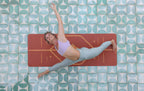
 Featured Yoga Mat: Tantalising Terracotta
Yin Yoga vs. Restorative Yoga: Key Differences
Core Purpose
Yin: Stretching the connective tissue around the joints
Restorative: Supporting your body for total relaxation
Use of Props
Yin: Uses props to help you find the proper amount of sensation
Restorative: Uses lots of props to completely support every part of your body
Pose Duration
Yin: Poses are held for three to five or more minutes
Restorative: Poses are held for five to ten or more minutes
Physical Sensation
Yin: Leaning into the edge of uncomfortable sensation
Restorative: Total relaxation and support
Best For
Yin: Yoga students who want to deepen their physical practice and explore their relationship with discomfort
Restorative: Yoga students who want a supportive, relaxing experience
Which One is Right for You?
You are overwhelmed or stressed
Choose restorative: Your nervous system needs to be soothed.
You want to sit in Lotus Pose
Choose Yin: When you’ve stretched your muscles as much as possible, working on your connective tissue is the next frontier. This is the purpose of Yin.
You need help getting to sleep
Choose restorative: Relaxing your body prepares you for sleep. Yin can have the opposite effect.
You’re up for a mental challenge
Choose Yin: In flowing Yoga styles, a pose you don’t care for will soon be over. Yin allows any discomfort to linger, which is challenging for your body and your mind.
You do a lot of vigorous Yoga or intense physical activity
Choose restorative or Yin: Both will help balance the faster, flowing style of Yoga and other types of exercise.
 Featured Yoga Mat: Liforme Classic Yoga Mat in Blue
Can You Practice Both Yin and Restorative Yoga?
Because of their different focuses, both Yin and restorative can have their place in your yoga rotation. Though they seem similar, each has a different methodology and purpose.
Yin is designed to fundamentally change your mobility while training your mind to handle discomfort.
Restorative is more like self-care: it offers a respite from the pressures and stressors of daily life.
The two practices complement each other and more flowy, heat-building types of yoga, like Vinyasa.
FAQs About Yin vs. Restorative Yoga
What is the difference between Yin and restorative yoga?
Yin is more about leaning into your edge to stretch your connective tissue. In restorative, your body is completely supported, so there are no edges to be found.
Is Yin or restorative yoga better?
Each is ideal for its intended purpose: stretching the connective tissue for Yin, and total relaxation for restorative.
Which is better for stress and anxiety, Yin or restorative yoga?
Both can work for this purpose. Restorative makes you feel safe and relaxed. Yin can be uncomfortable, which helps train your mind to handle stress. Try both and see which one works for you.
Can beginners do Yin or restorative yoga?
Restorative is great for beginners. Yin should be approached with a little more caution because it was developed for more experienced yogis.
Which style uses more props, Yin or restorative yoga?
Restorative generally uses more props. To support your whole body, several bolsters, blankets, blocks, and straps can all come into play.
Can I do both Yin and restorative yoga in the same week?
If you enjoy both these practices, there’s no reason not to do them in the same week.