€ EUR
€ EUR

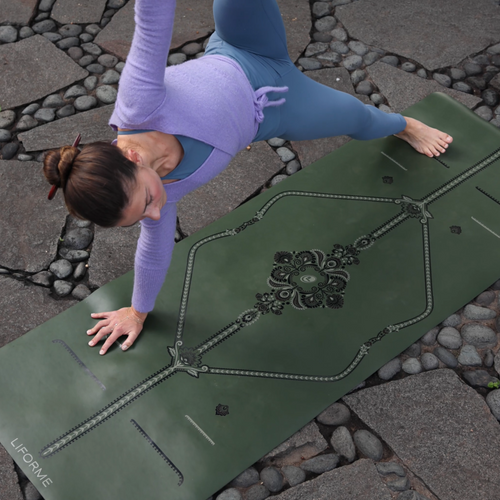
Revolved Triangle Pose (Parivrtta Trikonasana in Sanskrit) is Triangle Pose with a twist. Sounds simple enough, but adding rotation brings with it a host of complications as your alignment is thrown off and your balance challenged. Working on Revolved Triangle will improve your strength, flexibility, and body awareness, so let’s dive in. Oh, and have a block handy!
Step-by-Step Instructions for Revolved Triangle Pose
1. Begin standing in Mountain Pose (Tadasana) at the front of your mat with your hands on your hips.
2. Step your left foot back 3 to 4 feet but keep both hips facing forward.
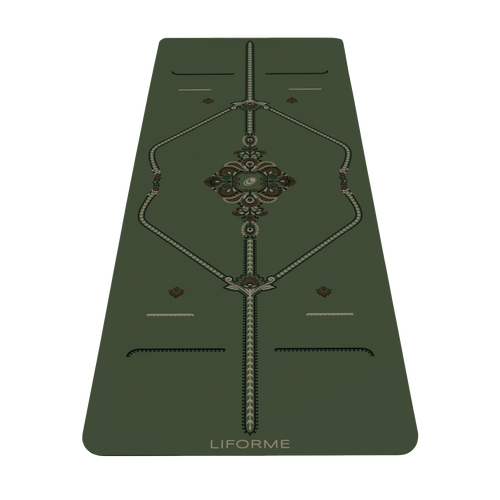
3. Turn your left toes out around 45 degrees using the 45-degree lines on your Liforme Mat. Ground into the soles of both feet.
4. Inhale to lift your arms and lengthen your spine, and exhale to forward fold over your right leg.
5. Take your left hand to the mat or a block outside of your right foot.
6. Press into your left palm and rotate your chest to the right to stack your right shoulder over your left shoulder.
7. Take the palm of your right hand to your sacrum to feel whether your hips changed position when you rotated your chest open. If they did, resquare your hips to the front of the mat by pulling your right hip back and your left hip forward.
8. Lift your right arm perpendicular to the floor and turn your head to gaze at your right hand.
9. After several breaths, release and do the other side.
🧘 Tip from a Yogi
"Although the pose is called Revolved Triangle, your feet and legs are actually in the same position as Pyramid Pose (Parsvottanasana), meaning a little shorter lengthwise and wider width-wise than Triangle. Revolved Pyramid might be a better name!"
Revolved Triangle Pose Basics
Sanskrit Meaning: Parivrtta (Revolved) Tri (Three) Kona (Angle) Asana (Pose)
Yoga Level: Intermediate
Pose Type: Standing
Pose Category: Twist
Common Props: Block
Benefits of Parivrtta Trikonasana
-
Improves your balance and core strength
-
Encourages spinal mobility and flexibility
-
Stretches your hamstrings, calves, and hips
-
Strengthens your legs

Key Alignment Cues
1. Hips Square
It’s really difficult to keep your hips square when you’re twisting your upper body, but that’s the crux of this pose. That’s why it’s a good idea to check your hips mid-way to make sure they are still level and pointed forward and to use a block under your hand. If you’re confused about what ‘hips square’ means, check out our Closed vs Open Hips explainer.
2. Lengthen Before You Twist
Give yourself the benefit of fully lengthening your spine before twisting your upper body. You’ll find a lot of extra room that way.
3. Stack Your Shoulders
Imagine a straight line from your lifted hand to your planted palm. If you can’t open your chest sufficiently with your hand on the floor, use a block under it.
Beginner Tips for Revolved Triangle Pose
-
Use a block under your bottom hand on any height that allows you to keep your hips square and open your chest fully.
-
Alternatively, take your bottom hand inside your front foot instead of outside it. You can also use a block here.
-
Widen your stance by moving your feet towards the sides of your mat for greater stability.
-
Avoid locking your front leg by keeping a microbend in the knee.
Preparatory Pose
 Pyramid Pose (Parsvottanasana)
Creates the foundation for the lower body in Revolved Triangle.
Counter Poses
 Triangle Pose (Trikonasana)
A counter twist to neutralise your spine.
 Garland Pose (Malasana)
Release your hamstrings with a deep squat.
Why We Practice Revolved Triangle Pose
We love a challenge pose and doing Revolved Triangle with optimal alignment definitely qualifies. It’s deceptively difficult to keep your hips squared while twisting, which is why a high percentage of yoga students will benefit greatly from using a block in this pose. Working on postures like this over time keeps your yoga practice inspiring and fun.
Revolved Triangle Pose FAQs
What is the difference between Triangle Pose and Revolved Triangle Pose?
Triangle Pose has a longer stance, the hips are in an open position, and you rotate your chest away from your front leg.
Revolved Triangle has a shorter stance, the hips are in a closed, or square, position and you rotate your chest toward your front leg.
The lower body in Revolved Triangle more closely resembles Pyramid Pose than Triangle Pose.
Is Revolved Triangle Pose beginner-friendly?
Beginners can try this posture with the support of a block, but it’s really more of an intermediate pose.
Who should avoid Parivrtta Trikonasana?
Full Parivrtta Trikonasana includes intense spinal rotation. If you’ve been advised to avoid this type of movement because of pain or injury, then avoid this pose.
How long should I hold Revolved Triangle Pose?
Try three to five breaths and see how you feel.