£ GBP
£ GBP

Are your feet killing you? If so, you’re not alone. Foot pain is super common, especially as we age. Some foot structures are prone to injury, and your shoes (heels), lifestyle (running), and even where you live (concrete jungle) can also play a part. Yoga can help by teaching you to activate your feet and by building foot strength and flexibility.
Yoga is almost always done barefoot, which gives the greatest benefits to your feet. If you suspect an injury or have severe pain, see a doctor for a diagnosis and advice on what kinds of movements to avoid. If you’re advised not to go barefoot, choose a shoe with as flexible a sole as possible for yoga.
The Importance of Active Feet
Just about every yoga pose offers the opportunity to prevent foot pain when you focus on keeping your feet actively engaged. Too often, we don’t pay adequate attention to how the feet are placed on the floor, or we let the foot hang limply when it’s lifted.
1. Root Your Feet
Your feet are the root of your stability in every standing pose, so they should be the first thing you think about. Make sure your feet are aligned correctly, whether that’s straight or at an angle. Press the balls of your feet down and root your heels. In most poses, ground your big toe but avoid gripping the toes.
2. Draw Your Arches Up
If you have flat feet that overpronate, draw your arches up to prevent your foot from collapsing inward, which affects your whole stance. Doing this consistently can help with many issues associated with flat feet.
3. Spread Your Toes
Whether your foot is planted on the mat or lifted toward the sky, spread your toes as wide as you can. This activates your whole foot.
4. No Limp Feet
In any pose where your foot is off the floor, keep your foot engaged and radiating energy. You can flex, point, or floint (pointed foot, flexed toes) your foot. Pointing your toes can cause cramping, so often a floint is a nice solution.
The 11 Best Yoga Poses for Your Feet
Toe & Sole Stretches
Stretch the often-neglected plantar fascia, toe joints, and soles to prevent foot pain.
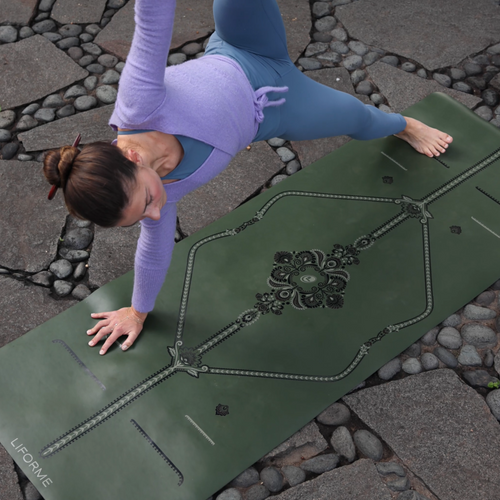
 Featured Yoga Mat: Liforme Classic Yoga Mat in Deep Forest Green
Toe Stand Prep
Yoga Level: Intermediate
Pose Type: Standing
Why This Pose: Challenge your balance and stretch the soles of your feet
Step-by-Step Instructions:
1. Stand in Mountain Pose (Tadasana)
2. Lift your heels and come onto the balls of your feet.
3. Extend your arm in front of you for balance.
4. Bend your knees and lower your seat to your heels.
5. Keep your spine perpendicular to the floor.
6. After three to five breaths, straighten your legs and lower your heels
 Featured Yoga Mat: Liforme X You Personalized Yoga Mat
Toe Stand (Padangusthasana)
Sanskrit Meaning: Padangustha (Big toe) Asana (Pose)
Yoga Level: Advanced
Pose Type: Standing
Why This Pose: Stretches and strengthens your feet
Step-by-Step Instructions:
1. Begin Half-Lotus Tree Pose with the top of your left foot pressing into your right hip crease.
2. Lift your right heel and come onto the ball of your right foot.
3. Bring your hands to Anjali mudra at your sternum.
4. Bend your right knee to lower your seat to your right heel. Try to center yourself on the heel.
5. Keep your spine long.
6. After three to five breaths, straighten your leg and lower your heel to return to standing.
7. Repeat on the second side.
Calf Stretches
Stretching your calves helps treat plantar fasciitis, an inflammation of the tissue on the sole of the foot.
 Featured Yoga Mat: Liforme Classic Yoga Mat in Grey
Reclined Big Toe Pose (Supta Padangusthasana)
Sanskrit Meaning: Supta (Supine) Padangustha (Big toe) Asana (Pose)
Yoga Level: Beginner
Pose Type: Supine
Why This Pose: Stretches your calves
Step-by-Step Instructions:
1. Lie on your back with a strap in your hands.
2. Bend your right knee into your chest and loop the strap around your instep.
3. Holding the ends of the strap, extend your right leg toward the ceiling.
4. Your left leg can be extended on the floor or bent with the knee pointing up.
5. On your inhales, gently pull the strap to draw your leg closer to your chest.
6. On your exhales, relax the strap slightly.
7. Repeat for five to ten breaths, then switch sides.
 Featured Yoga Mat: Majestic Carpet in Maroon
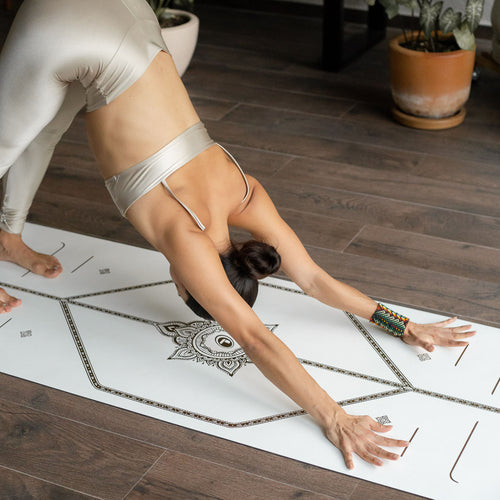
Downward Facing Dog (Adho Mukha Svanasana)
Sanskrit Meaning: Adho (Downward) Mukha (Facing) Svana (Dog) Asana (Pose)
Yoga Level: Beginner
Pose Type: Standing
Why This Pose: A good stretch for the calves, feet, and ankles
Step-by-Step Instructions:
1. Begin in a hands and knees tabletop position.
2. Curl your toes and press into your palms to lift your hips toward the ceiling.
3. Release your heels toward the floor.
4. Pedal your legs by bending one knee at a time.
Ankle Mobility Exercises
Moving your ankle joints reduces stiffness from sitting and helps prevent shin splints.
 Featured Yoga Mat: Tantalizing Terracotta
Downward Facing Dog Split (Adho Mukha Svanasana)
Sanskrit Meaning: Adho (Downward) Mukha (Facing) Svana (Dog) Asana (Pose)
Yoga Level: Beginner
Pose Type: Standing
Why This Pose: An opportunity to rotate your ankles
Step-by-Step Instructions:
1. Begin in Downward Facing Dog
2. Lift your left leg as high as possible without opening your hips.
3. Let your right heel sink towards the floor.
4. Circle your left foot clockwise five times, then counterclockwise five times.
5. Lower your left leg and repeat on the second side.
 Featured Yoga Mat: Liforme Classic Yoga Mat in Purple
Thunderbolt Pose (Vajrasana)
Sanskrit Meaning: Vajra (Thunderbolt) Asana (Pose)
Yoga Level: Beginner
Pose Type: Seated
Why This Pose: Use your bodyweight to stretch the tops and soles of the feet
Step-by-Step Instructions:
1. Begin in a kneeling position with your hips over your knees and the tops of your feet on the mat.
2. Sit back on your heels.
3. After several breaths, come back up.
4. Tuck your toes under so you’re on the balls of your feet.
5. Sit back on your heels while keeping the toes tucked.
6. After several breaths, come forward onto your hands and knees.
7. Lightly tap the tops of your feet on the mat a few times.

Pyramid Pose (Parsvottanasana)
Sanskrit Meaning: Parsva (Side) Uttana (Intense Stretch) Asana (Pose)
Yoga Level: Beginner
Pose Type: Standing
Why This Pose: Practice engaging your arches
Step-by-Step Instructions:
1. From Mountain Pose, step your left foot back around three feet.
2. Turn your left toes out around 45 degrees.
3. Adjust your stance so that your hips face forward and both feet are flat on the floor. You can also widen your feet toward the long sides of your mat for more stability.
4. With both legs straight, forward fold over your right leg, bringing your hands to the floor or onto blocks.
5. Now that you can see your feet, press into the balls of your feet and draw your arches up.
6. Remember to engage your arches in standing poses.
 Featured Yoga Mat: Cosmic Moon XL in Dusk Blue
Standing Split (Urdhva Prasarita Eka Padasana)
Sanskrit Meaning: Urdhva (Upward) Prasarita (Spread Out) Eka (One) Pada (Foot) Asana (Pose)
Yoga Level: Beginner
Pose Type: Standing
Why This Pose: One-legged balances build foot strength
Step-by-Step Instructions:
1. From Mountain Pose, forward bend while lifting your left leg off the floor.
2. Bring your hands to the floor or onto blocks.
3. Activate your lifted foot and flare your toes.
4. Draw up the arch of your standing foot.
5. For an added balance challenge, take one or both hands to your right ankle.
6. It’s normal for your standing foot to shake a little.
7. Release your left leg and repeat on the second side.
 Featured Yoga Mat: Mindful Garden in Olive
Tree Pose (Vrksasana)
Sanskrit Meaning: Vrks (Tree) Asana (Pose)
Yoga Level: Beginner
Pose Type: Standing
Why This Pose: One-legged balances build foot strength
Step-by-Step Instructions:
1. From Mountain Pose, bring the sole of your left foot to your inner right thigh with your left knee pointing to the left.
2. Press your foot into your leg and your leg back into your foot to keep your hips square.
3. Bring your hands to Anjali mudra at your sternum or lift your arms toward the ceiling.
4. It’s normal to wobble a bit as your body shifts to keep balance.
5. Release your left leg and repeat on the second side.
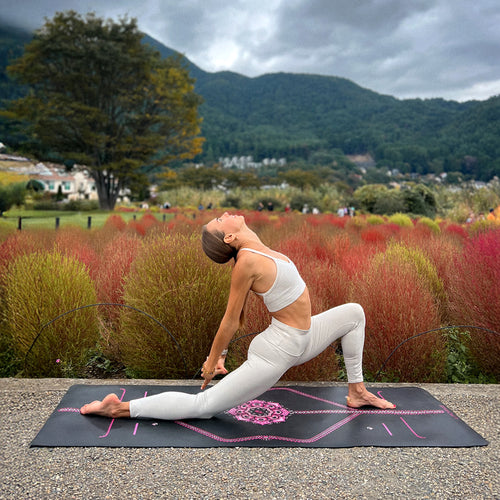
 Featured Yoga Mat: Cosmic Moon in Black
Goddess Pose (Utkata Konasana)
Sanskrit Meaning: Utkata (Powerful) Kona (Angle) Asana (Pose)
Yoga Level: Beginner
Pose Type: Standing
Why This Pose: Strengthens your feet
Step-by-Step Instructions:
1. Face the long side of your mat with your feet in a wide stance.
2. Turn your toes out 45 degrees.
3. Bend your knees and stack your knees over your ankles.
4. Lift your heels off the floor so you are on the balls of your feet.
5. Hold for three to five breaths, then release your heels.
6. Repeat two more times.
Relaxation & Recovery
Improve your circulation and give your feet a break at the end of the day.
 Featured Yoga Mat: Liforme Classic Yoga Mat in Blue
Legs Up the Wall (Viparita Karani)
Sanskrit Meaning: Viparita (Inverted) Karani (To Do)
Yoga Level: Beginner
Pose Type: Inversion
Why This Pose: Put your feet up!
Step-by-Step Instructions:
1. Sit at the wall with your left side touching the wall and your knees bent.
2. Roll onto your back, bringing your legs up the wall at the same time.
3. Relax here for several minutes.
4. To come out, bend your knees and roll to your side.
Benefits of Foot Yoga Poses
-
Build foot strength
-
Improve flexibility and mobility of the ankles
-
Support your arches
-
Stretch your calves and tibialis muscles (associated with shin splints)
Best Feet Forward
Yoga’s whole-body approach means that your feet are not overlooked. Make a point of bringing your attention to what your feet are doing in every pose. Keeping them active and engaged throughout not only prevents foot pain, it improves your practice.
FAQs About Yoga for Feet
Can yoga really help with foot pain?
Yes, it can! Many types of foot pain are caused by weakness and lack of flexibility, which yoga addresses. It’s always a good idea to see a podiatrist if your pain is severe or persistent.
Which yoga pose is best for plantar fasciitis?
Calf stretches like Reclined Big Toe Pose and Downward Facing Dog can help treat plantar fasciitis. See a physical therapist for other exercises that target this condition.
Can yoga strengthen your feet?
Absolutely! Because yoga is done barefoot, you have to use your feet more than when you are wearing shoes.
Can I do these exercises if I have flat feet or fallen arches?
Learning to engage and lift your arches is a good habit for flat feet. For fallen arches, follow your doctor’s recommendations.
Do I need any equipment for foot yoga?
Just a supportive yoga mat and a strap!
Are these poses safe for older adults or beginners?
Pose levels are noted above, and many of them are great for people of any age who are new to yoga.