€ EUR
€ EUR

Stress relief is one of the top overall benefits of yoga, full stop. Yes, improving your strength, flexibility, and balance are great, but when it comes to quality of life, lowering your stress levels is a complete game-changer. And, because high stress has such a detrimental effect on so many aspects of your physical and mental health, the knock-on benefits of reducing stress with yoga are innumerable.
There are many reasons why yoga is so effective in fighting stress, including its movement style, the way it fosters stronger mind-body connections, and its incorporation of breathing exercises and meditation. But none of these things work as well without consistency. To truly tap into yoga’s destressing power, you need to make a habit of this practice.
6 Ways Yoga Relieves Stress
Any movement is good
Exercise in general has a positive effect on your stress levels by stimulating the release of endorphins, which are often called feel-good hormones. Yoga asana, or poses, certainly works this way.
Stretching releases tension
Yoga’s focus on stretching is especially good at releasing the tension and tightness that go along with stress. Stretching your hips and shoulders really allows you to let go while also improving mobility, which helps you feel better in your body.
Stimulates rest and digest hormones
Pranayama (breathing exercises) and meditation, which often accompany the practice of yoga poses, activate your parasympathetic nervous system, encouraging your body to shift away from ‘fight or flight’ mode into ‘rest and digest’, which helps you relax.
[Image of the parasympathetic nervous system function]
Gives your brain a break
Yoga’s intense physicality occupies your entire attention, keeping you firmly in your body and out of your head. Vigorous, alignment-centred practices work just as well, and sometimes even better than, gentle ones for this purpose.
Helps you focus on the present
Yoga asana, pranayama, and meditation are all excellent ways to focus your mind on the present moment rather than ruminating on the past or anticipating the future.
Final relaxation
Every yoga session ends with Corpse Pose (Savasana), a period of five to ten minutes during which your only job is to lie still. After the exertion of your practice, this respite prepares you to re-enter your day with a new mindset.
The Best Yoga Poses for Stress Relief
If you’ve been wanting to try yoga for stress relief but don’t think you have the time or the skill, these poses are for you. The most important thing is to be consistent. A regular short practice is more effective than a longer session every once in a while.
Try to include hip openers, hamstring stretches, backbends, twists, balancing poses, and inversions. If you know other poses, feel free to substitute!
Warm-Up Stress Relief Poses
Start your practice with a few gentle stretches for your back and shoulders.
 Featured Yoga Mat: Blossoming Lotus Yoga Mat – Purple
Cat-Cow Stretch (Marjaryasana-Bitilasana)
Sanskrit Meaning: Marjary (Cat) Bitil (Cow) Asana (Pose)
Yoga Level: Beginner
Pose Type: Kneeling
Why this Pose: Moving your spine releases tension
Step-by-Step Instructions:
- Begin in a hands-and-knees position with your shoulders over your wrists and your hips over your knees.
- On your inhalations, lift your head and tail while lowering your belly.
- On your exhalations, tuck your tail, round your spine toward the ceiling, and lower your head.
- Repeat these movements for 5-10 breath cycles.
 Featured Yoga Mat: Liforme Tropical Paradise Yoga Mat
Thread the Needle Pose (Urdhva Mukha Pasasana)
Sanskrit Meaning: Urdhva (Upward) Mukha (Facing) Pasa (Noose) Asana (Pose)
Yoga Level: Beginner
Pose Type: Kneeling
Why this Pose: This upper body twist is especially good at loosening tight shoulders
Step-by-Step instructions:
- From a hands-and-knees position, thread your right arm under your left arm
- Extend your right arm to the left until your right shoulder and temple come to the floor.
- For a deeper stretch, reach your left arm forward and come onto your fingertips.
- After 5-10 breaths, unwind and repeat on the other side.
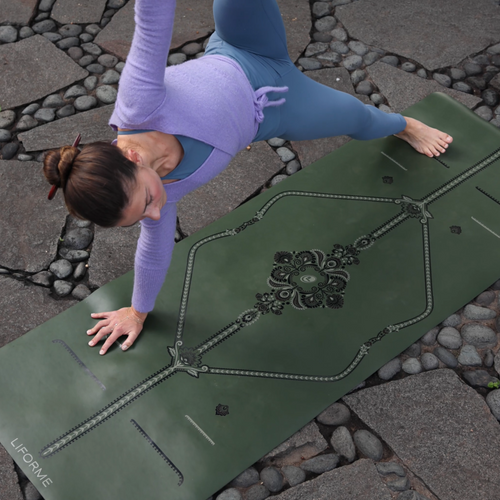
 Featured Yoga Mat: Liforme Classic Yoga Mat - Green
Eye of the Needle Pose (Sucirandhrasana)
Sanskrit Meaning: Suci (Needle) Randra (Opening) Asana (Pose)
Yoga Level: Beginner
Pose Type: Supine
Why this Pose: A gentle hip opener that’s adaptable for every level of flexibility
Step-by-Step Instructions:
- Lie on your back with your knees bent and the soles of your feet on the floor.
- Hug your right knee into your chest.
- Place your right ankle on your left thigh close to the knee.
- Open your right knee to the right.
- To intensify the stretch, lift your left foot and hold onto the back of your left thigh with both hands while keeping your head and shoulders on the floor.
- After 5-10 breaths, release and switch sides.
 Featured Yoga Mat: Mindful Garden Yoga Mat - Purple
Pigeon Prep (Eka Pada Rajakapotasana Prep)
Sanskrit Meaning: Eka (One) Pada (Foot) Raja (King) Kapota (Pigeon)
Yoga Level: Beginner
Pose Type: Prone
Why this Pose: For those who want a little more intensity
Props: Blanket or bolster
Step-by-Step Instructions:
- Begin in a hands-and-knees position.
- Bring your right knee forward to the outside of your right hand.
- Take your right ankle behind your left hand so your right shin is approximately parallel to the front edge of your mat.
- Extend your left leg straight behind you.
- Lower to your elbows and bring some weight onto your right hip.
- If there is a lot of space between your right hip and the floor, fill the gap with a blanket or bolster for support.
- After 5-10 breaths, return to your hands and knees and repeat on the other side.
Hamstring Stretch Stress Relief Poses
Counter the effects of too much time spent sitting.
 Featured Yoga Mat: Liforme x You Personalised Yoga Mat
Wide-Legged Standing Forward Bend Pose (Prasarita Padottanasana)
Sanskrit Meaning: Prasarita (Spread Out) Pada (Feet) Uttana (Intense) Asana (Pose)
Yoga Level: Beginner
Pose Type: Standing
Why this Pose: This forward fold is easy to adjust. Just take your feet wider or narrower to find the stretch that feels good. It’s also an inversion!
Props: Blocks
Step-by-Step Instructions:
- Face the long side of your yoga mat in a standing position with your feet wide apart and parallel.
- Take your hands to your hips
- Tip your pelvis forward to come into a forward bend.
- Release your hands to the floor or to blocks.
- Stay 5 to 10 breaths.
 Featured Yoga Mat: Liforme Radiant Sun Yoga Mat - Yellow
Triangle Pose (Trikonasana)
Sanskrit Meaning: Tri (Three) Kona (Angle) Asana (Pose)
Yoga Level: Beginner
Pose Type: Standing
Why this Pose: Stretch your hamstrings and open your chest to relieve tension.
Props: Block
Step-by-Step Instructions:
- Begin in a wide straddle facing the long side of your mat with your feet parallel.
- Turn your right toes to the front on your mat.
- Keeping both legs straight, extend your right arm to the front of the room.
- When you’ve reached as far as you can, lower your right hand to your shin, ankle, or a block inside or outside your right foot.
- Stack your left shoulder over the right and reach your left arm straight to the ceiling.
- Turn your head to take your gaze to your left fingers.
- After 3 to 5 breaths, return to standing and switch sides.
Backbending Stress Relief Poses
Open your heart and mobilize the spine.
 Featured Yoga Mat: Liforme Classic Yoga Mat - Grey
Sphinx Pose (Salamba Bhujangasana)
Sanskrit Meaning: Salamba (Supported) Bhujanga (Cobra) Asana (Pose)
Yoga Level: Beginner
Pose Type: Backbend
Why this Pose: An antidote to sitting and looking at screens.
Step-by-Step Instructions:
- Lie on your belly with your forearms parallel and your shoulders stacked over your elbows.
- Press into your forearms to release your shoulders, lengthen your neck, and open your chest.
 Featured Yoga Mat: Liforme Classic Yoga Mat – Purple Earth
Bridge Pose (Setu Bandhasana)
Sanskrit Meaning: Setu (Bridge) Bandha (Lock) Asana (Pose)
Yoga Level: Beginner
Pose Type: Supine Backbend
Why this Pose: A gentle backbend that improves spinal mobility.
Step-by-Step Instructions:
- Lie on your back with your knees bent, soles on the floor, and arms along your sides.
- Press into your feet and use your glutes to lift your hips away from the floor.
- Tuck each shoulder under and interlace your hands behind your back.
- Continue to lift your hips.
- Stay here up to five breaths before releasing your hands and lowering your hips to the floor.
- Repeat two more times.
Twisting Stress Relief Poses
After a good twist, your body feels looser.
 Featured Yoga Mat: Liforme Radiant Sun Yoga Mat - Yellow
Abdominal Twist (Jathara Parivartanasana)
Sanskrit Meaning: Jathara (Abdomen) Parivartana (Revolved) Asana (Pose)
Yoga Level: Beginner
Pose Type: Supine
Why this Pose: Improves your digestion and passively releases the spine
Props: Bolster, blocks, or blanket
Step-by-Step Instructions:
- Lie on your back with your knees bent and soles on the floor.
- Press into your feet and scoot your hips a few inches to the right.
- Let your knees fall to the left.
- Extend your arm in a T or cactus shape.
- Keep your right shoulder grounded on the mat.
- Take a prop under your left knee if they don’t come to the floor.
- Stay as long as you like, then switch sides.
 Featured Yoga Mat: Liforme Classic Yoga Mat - Grey
Seated Spinal Twist (Ardha Matsyendrasana)
Sanskrit Meaning: Ardha (Half) Matsyendra (Lord of Fishes) Asana (Pose)
Yoga Level: Beginner
Pose Type: Seated
Why this Pose: Provides an opportunity for deeper abdominal rotation.
Step-by-Step Instructions:
- Begin in a comfortable, cross-legged position (Sukhasana).
- Take your right foot flat on the floor outside of your left thigh with your knee pointing up.
- Bring your left foot outside your right hip with the top of the foot on the floor.
- Inhale to lengthen your spine.
- Exhale and twist to the right, planting your right hand to the floor behind your spine.
- Take your left elbow outside your right knee.
- Stay for 3 to 5 breaths, lengthening on the inhales and rotating on the exhale.
- Release and switch sides.
Balancing Stress Relief Poses
Balancing poses require your full attention, which helps clear your mind.
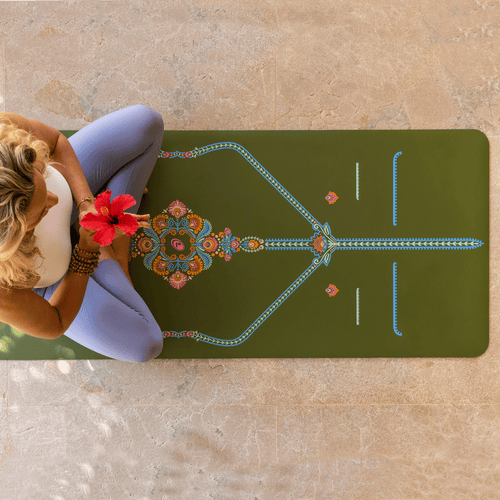
 Featured Yoga Mat: Mindful Garden Yoga Mat - Olive
Tree Pose (Vrksasana)
Sanskrit Meaning: Vrksa (Tree) Asana (Pose)
Yoga Level: Beginner
Pose Type: Standing
Why this Pose: A good introduction to balancing on one leg.
Step-by-Step Instructions:
- Begin in Mountain Pose (Tadasana)
- Without shifting your hips, take your weight into your right leg.
- Lift your left foot off the floor.
- Take the sole of your left foot to your inner right thigh to calf.
- Place your hands on your hips to make sure they are still in Mountain Pose position.
- Keeping your head in a neutral position, take your arms up to the ceiling.
 Featured Yoga Mat: Liforme Radiant Sun Yoga Mat - Yellow
Half Moon Pose (Ardha Chandrasana)
Sanskrit Meaning: Ardha (Half) Chandra (Moon) Asana (Pose)
Yoga Level: Intermediate
Pose Type: Standing
Why this Pose: In addition to stretching your hamstrings, this standing balance requires you to focus on your alignment, which helps anchor your awareness in your body.
Props: Block
Step-by-Step Instructions:
- Begin in Triangle Pose (Trikonasana) with the right leg forward.
- Bend your right knee and take your right hand about 8 inches to the front and outside of your right foot. You may want to use a block.
- Lift your left foot and straighten your right leg to take your weight into the right leg.
- Take your left leg parallel to the floor with the toes pointing out in an open-hipped position.
- Adjust your right hand if necessary to bring it directly under your right shoulder.
- Extend your right arm and your gaze to the ceiling.
- After 3 to five breaths, lower your left foot and switch sides.
Inverted Stress Relief Poses
Improve circulation and clear your mind.
 Featured Yoga Mat: Liforme Classic Yoga Mat - Blue
Legs Up the Wall Pose (Viparita Karani)
Sanskrit Meaning: Viparita (Inversion) Karani (to do)
Pose Type: Inversion
Precautions: Avoid inversions if you have glaucoma or high blood pressure
Why this Pose: A relaxing inversion that gives your legs a break
Step-by-Step Instructions:
- Bring your mat over to a wall and sit with your knees bent, soles on the floor, and side touching the wall.
- Roll onto your back and take your legs up the wall.
- Stay as long as you like.
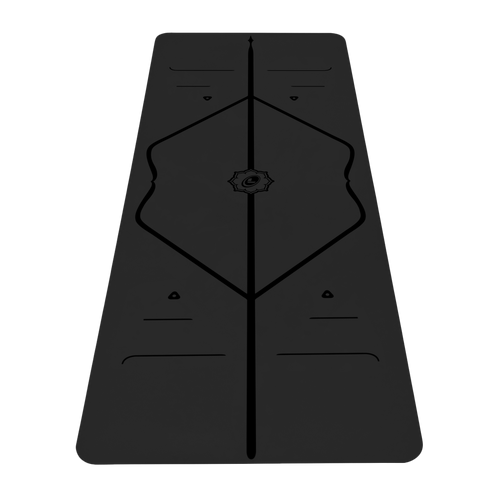
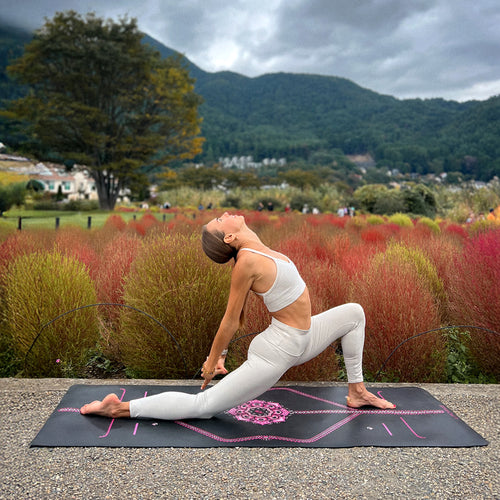
 Featured Yoga Mat: Cosmic Moon Yoga Mat - Black
Headstand (Salamba Sirsasana I)
Sanskrit Meaning: Salamba (Supported) Sirsa (Head) Asana (Pose)
Yoga Level: Intermediate
Pose Type: Inversion
Precautions: Avoid inversions if you have glaucoma or high blood pressure
Why this Pose: If more advanced inversions like headstand and handstand are in your practice, they’re a great way to clear your mind
Step-by-Step Instructions:
- Come into your hands and knees.
- Lower your forearms to the mat parallel, then interlace your hands without moving your elbows.
- Take the crown of your head to the floor with your interlaced fingers cradling the back of your head.
- Curl your toes under and lift your hips like you would in Downward Facing Dog.
- Walk your feet in until your hips are over your shoulders.
- Press strongly into your forearms and lift one leg straight up.
- Take your weight forward slightly to lift your other leg off the floor.
- Slowly bring both legs to a vertical position.
- After 5 breaths, lower one leg at a time.
Breathwork & Meditation for Stress Relief
Learning how to control your breathing and meditate can also be very useful in reducing stress. If you are new to these practices, here’s how to get started with meditation.
 Featured Yoga Mat: Liforme Majestic Carpet Yoga Mat - Maroon
Equal Breathing (Sama Vritti)
Why this Technique: Slowing down and equalising your inhales and exhales relaxes the nervous system, sending the body the message that it is safe.
Step-by-Step Instructions:
- Sit in Easy Pose (Sukhasana) or Hero Pose (Virasana). Sit on a block, blanket, or bolster to get more comfortable.
- Inhale through your nose for a count of four.
- Retain your breath for a count of four.
- Exhale for a count of four.
- Stay empty for a count of four.
- Repeat this pattern for several cycles.
- Try lengthening your count to five or six if that seems possible.
 Alternate Nostril Breath (Nadi Shodhana)
Why this Technique: Calms the body and bring it into balance.
Step-by-Step Instructions:
- Find a comfortable seat.
- Bring the forefinger and middle finger of your right hand to the center of your forehead with your thumb near your right nostril and ring finger near your left nostril.
- Use your thumb to close your right nostril while you inhale through the left nostril.
- Use your ring finger to close your left nostril while you exhale through the right nostril.
- Inhale through the right nostril.
- Exhale through the left nostril.
- Inhale through the left nostril.
- Exhale through the right nostril.
- Continue this pattern for several more cycles of breathe.
Why We Practice Yoga to Relieve Stress
So many people live with debilitating stress day in and day out without the proper tools for self-regulation. Yoga is proven to offer those tools in an accessible way that you can adapt to your lifestyle. With all we know about the effects of stress on health and well-being, trying yoga for stress only makes sense.
Yoga for Stress Relief FAQs
Can yoga really reduce stress?
Yes, it can! Anecdotal evidence abounds, and scientific studies agree.
What type of yoga is best for stress relief?
The kind that you do consistently. Any type of yoga can reduce stress, so pick one that you enjoy and will do regularly.
How often should I practise yoga for stress relief?
Ideally, three or more times per week, but you don’t have to do an hour+ every time. Even 10 or 15 minutes a day can make a difference.
What is the best time of day to do yoga for stress?
The specific time of day doesn't really matter. What’s more important is to find the time that allows you to do it consistently.
Is yoga for stress suitable for everyone?
Yoga works for most bodies because it’s extremely adaptable. There are even practices that can be done sitting in a chair or by focusing on your breath.