£ GBP
£ GBP

Yoga poses for core strength target the muscles of your torso, including the abs, obliques, and back, that support your spine, affect your posture, and integrate the workings of your upper and lower body. While many workouts approach the abdominals in a fairly superficial way, yoga gets deep into your midsection, building functional strength, which is great for your long-term fitness, balance, and health.
A number of variations on crunches and planks are taught in many fitness-oriented yoga classes, but any pose that improves your balance will strengthen your core along the way. We’ll highlight some of our favourite core-strengthening poses, talk about how to access your deep core, and offer plenty of alignment tips to make sure you’re getting the most out of every posture.
12 Yoga Poses for Core Strength
 Yoga Mat featured: Liforme Classic Yoga Mat - Olive
Balancing Table Pose (Dandayamana Bharmanasana)
Sanskrit Meaning: Danda (Staff) Yamana (Restraining) Bharmana (Table) Asana (Pose)
Also Known As: Bird Dog Pose
Yoga Level: Beginner
Pose Type: Kneeling
Why this Pose: Destabilizing the body strengthens your core.
Step-by-Step Instructions:
- Start in a hands-and-knees tabletop position with your hips over your knees and your shoulders over your wrists.
- Extend your left leg behind you and lift it parallel to the floor.
- Keep both hips square to the floor and flex your left foot.
- Extend your right arm forward, parallel to the floor.
- Keep your neck in a neutral position.
- After several breaths, return to a tabletop and switch sides.
Extra Challenge: Round your spine and bring your opposite knee and elbow to meet under your body on an exhalation. Repeat several times, inhaling to extend and exhaling to bring the knee and elbow together.
 Yoga Mat featured: Liforme Cosmic Moon Yoga Mat - Dusk Blue
Plank Pose (Phalakasana)
Sanskrit Meaning: Phalaka (Plank) Asana (Pose)
Yoga Level: Beginner
Pose Type: Arm Support
Why this Pose: Keeping your body straight works all the core-stabilizing muscle groups.
Step-by-Step Instructions:
- Start in a hands-and-knees tabletop position.
- Extend your legs back one at a time, curling your toes under.
- Keep your shoulders over your wrists and a straight line from your head to your heels.
Extra Challenge: Hold Plank for up to a minute.
 Yoga Mat featured: Liforme Tropical Paradise Yoga Mat - Aqua Teal
One-Legged Plank (Eka Pada Phalakasana)
Sanskrit Meaning: Eka (One) Pada (Foot) Phalaka (Plank) Asana (Pose)
Yoga Level: Intermediate
Pose Type: Arm Support
Why this Pose: Lifting one leg is destabilizing, which activates your core to maintain balance.
Step-by-Step Instructions:
- Begin in Plank Pose.
- Without lifting your hips, raise your right leg away from the floor about six inches.
- Hold for three to five breaths, or longer if you can.
- Switch sides.
Extra Challenge: Bring your right knee to touch your right elbow. Hold for a breath and then reextend your leg.
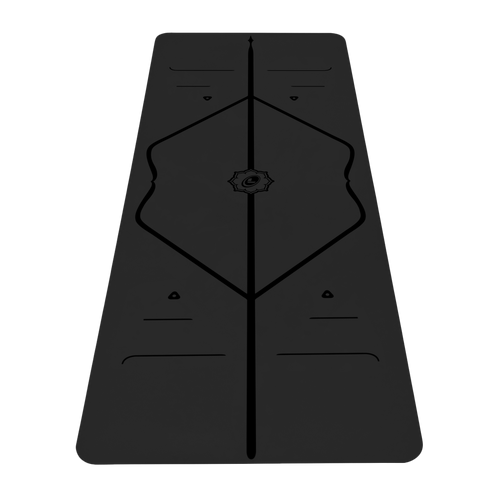
 Yoga Mat featured: Liforme Black & Gold Yoga Mat - Black
Side Plank (Vasisthasana)
Sanskrit Meaning: Vasistha (An ancient poet and sage) Asana (Pose)
Yoga Level: Intermediate
Pose Type: Arm Support
Why this Pose: Targets your oblique muscles.
Step-by-Step Instructions:
- Begin in Plank Pose.
- Roll to the outside of your left foot and lift your right arm as you rotate your body to face the right.
- Lift your hips.
- Stay for three to five breaths, or longer if you can.
- Switch sides.
Extra Challenge: Lift your right leg away from your left any amount. Hold this position for several breaths or lift and lower the right leg several times.
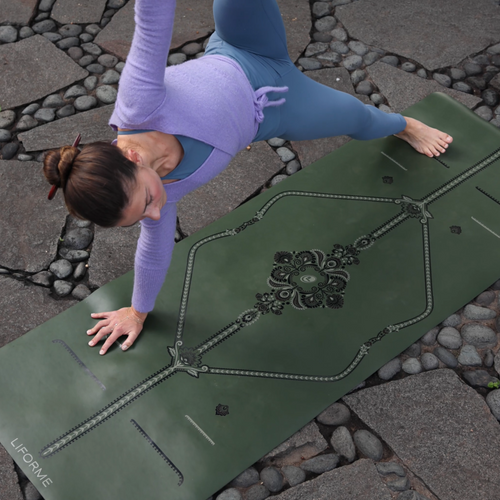
 Yoga Mat featured: Liforme Classic Yoga Mat - Deep Forest Green
Forearm Plank
Yoga Level: Beginner
Pose Type: Arm Support
Why this Pose: When your body is parallel to the floor, it’s harder to resist the pull of gravity, so this position works the abdominal muscles more.
Step-by-Step Instructions:
- Begin in Sphinx Pose with your forearms parallel and shoulders over your elbows.
- Curl your toes under and lift your pelvis and legs off the floor.
- Press into your forearms to keep your shoulder blades broad.
- Hold this position as long as possible without losing your alignment.
Extra Challenge: Press back into your heels and then come forward onto your toes. Move back and forth like this as many times as you can.
 Yoga Mat featured: Liforme Paisley Passion Yoga Mat - Olive
Dolphin Pose (Ardha Pincha Mayurasana)
Sanskrit Meaning: Ardha (Half) Pincha (Feathered) Mayur (Peacock) Asana (Pose)
Yoga Level: Intermediate
Pose Type: Inversion
Why this Pose: Strengthens your abdomen and back.
Step-by-Step Instructions:
- Begin in Forearm Plank.
- Walk your feet as close to your elbows as possible.
- Hold this position for five breaths or longer.
- Lower your knees to the mat to come out.
Extra Challenge: In Forearm Plank, interlace your hands. Lift your hips to Dolphin. Without changing the position of your feet, move back and forth between Forearm Plank and Dolphin several times.
 Yoga Mat featured: Liforme Classic Yoga Mat - Pink
Boat Pose (Navasana)
Sanskrit Meaning: Nava (Boat) Asana (Pose)
Yoga Level: Beginner
Pose Type: Seated
Why this Pose: The abdominal muscles work against gravity to keep your torso lifted.
Step-by-Step Instructions:
- Begin in a sitting position with your feet on the floor and knees bent toward the ceiling.
- Lean your upper body back slightly and lift your shins to parallel with the floor.
- Lift and extend your arms to either side of your body.
- Work to keep your thighs and torso lifted.
- Extend your legs straight only if you can maintain the position of your torso.
Extra Challenge: Move back and forth between Boat and Low Boat with your legs extended and shoulders and feet hovering off the floor.
 Yoga Mat featured: Liforme Classic Yoga Mat - Purple
Low Cobra (Bhujangasana)
Sanskrit Meaning: Bhujanga (Cobra) Asana (Pose)
Yoga Level: Beginner
Pose Type: Prone Backbend
Why this Pose: Engages and strengthens the lower back muscles.
Step-by-Step Instructions:
- Lie on your stomach with your palms flat beside your chest and your elbows bent straight back.
- Anchor your pelvis and the tops of your feet to your mat.
- On an inhalation of breath, lift your upper chest, shoulders, and head off the floor without pressing into your hands.
- Release on the next exhale.
Extra Challenge: Repeat this three times or hold the Cobra position for several rounds of breath.
 Yoga Mat featured: Liforme Classic Yoga Mat - Purple
Bridge Pose (Setu Bandhasana)
Sanskrit Meaning: Setu (Bridge) Bandha (Lock) Asana (Pose)
Yoga Level: Beginner
Pose Type: Supine Backbend
Why this Pose: Strengthen your back muscles and glutes as they work to stay elevated.
Step-by-Step Instructions:
- Lie on your back with your feet flat and knees pointing upward.
- Bring your heels close to your butt.
- On an inhalation, press into your feet and use your glutes to lift your pelvis.
- Tuck your shoulders under and interlace your hands behind your back.
- Stay for three or more breaths and release on an exhalation.
Extra Challenge: Lift and lower three times.
 Yoga Mat featured: Liforme Classic Yoga Mat - Olive
Chair Pose (Utkatasana)
Sanskrit Meaning: Utkata (Powerful) Asana (Pose)
Yoga Level: Beginner
Pose Type: Standing
Why this Pose: The entire core works to maintain the squat and lift the arms.
Step-by-Step Instructions:
- Stand at the front of your mat in Mountain Pose (Tadasana).
- Bend your knees and lower your seat down and back.
- Make sure you can see your toes in front of your knees.
- Lift your arms overhead.
- Stay three or more breaths.
Extra Challenge: Intensify the box by lowering your seat.
 Yoga Mat featured: Liforme XL Mountain Yoga Mat - Black
High Lunge
Yoga Level: Intermediate
Pose Type: Standing
Why this Pose: Keeping your balance and lifting your arms works the whole core.
Step-by-Step Instructions:
- From Mountain Pose, step your left foot to the back of the mat.
- Stay on the ball of your left foot.
- Bend your right knee over your right ankle.
- Lift your arms overhead.
- Stay five breaths or longer.
- Step to the front of your mat and switch sides.
Extra Challenge: Lower your left knee to hover a few inches above your mat, then straighten your left leg. Repeat this several times.
 Yoga Mat featured: Liforme Radiant Sun Yoga Mat - Yellow
Half Moon Pose (Ardha Chandrasana)
Sanskrit Meaning: Ardha (Half) Chandra (Moon) Asana (Pose)
Yoga Level: Intermediate
Pose Type: Standing
Why this Pose: Standing on one leg and keeping the other one elevated works the whole core.
Step-by-Step Instructions:
- From Mountain Pose, forward bend, taking your right hand to the floor or a block about six inches in front of your right foot and your left hand to your left hip.
- Lift your left leg and open your left hip so that your pelvis and ribcage face left.
- Keep your left leg parallel to the floor and flex your left foot.
- Take your left arm and your gaze toward the ceiling.
- After five breaths or more, release and switch sides.
Extra Challenge: Float your right fingers off the floor.
Tips on Activating Your Deep Core
Balancing, yoga poses, and general physical activity become more accessible when you learn how to access the core muscles in your abdomen, back, and pelvis.
-
Bring your awareness to your core
The first step is to simply turn your attention to your core muscles throughout your practice. Where your awareness goes, activation follows.
-
Engage your navel
Gently draw your navel toward your spine. Practice this in Cat-Cow Stretches (Marjaryasana-Bitilasana). Even when your belly is lowered in Cow Pose, keep drawing in the navel.
-
Lift your pelvic floor
Think of this like a Kegel. In yoga, this action is called Mula Bandha, or the Root Lock.
-
Use your back muscles
In Low Cobra (above), don’t press into your hands to lift your chest away from the floor. You probably won’t come up as high, but your back muscles will get stronger.
Benefits of Yoga for Core Strength
- Improved posture
- Better balance and stability
- Reduced lower back pain
- Increased body awareness
- Access to more advanced yoga poses
Do More for Your Core
Any yoga you do consistently will improve your core strength over time, especially if you get in the habit of engaging your core throughout your practice. Add in a few of the challenge poses listed above, and you’ll soon find yourself with better balance on and off your yoga mat.
Yoga for the Core FAQs
Does yoga improve core strength?
Yes, yoga is a great way to improve your core strength. In addition to the poses above, flow yoga (vinyasa) is particularly good for the core because the movement from pose to pose requires balance and agility.
How often should I do yoga poses for core strength?
To see improvement, try to practice three times a week for 30-60 minutes. Consistency is more important than duration.
What is the fastest way to strengthen your core with yoga?
Regular yoga practice over time will improve your core strength. If you want to up the intensity, you can try adding dynamic movement. For instance, moving slowly from Boat to Low Boat or lowering your back knee toward the floor from High Lunge.
When practicing yoga for core strength, are there any common mistakes to avoid?
If your mind wanders, bring your attention back to your core again and again.